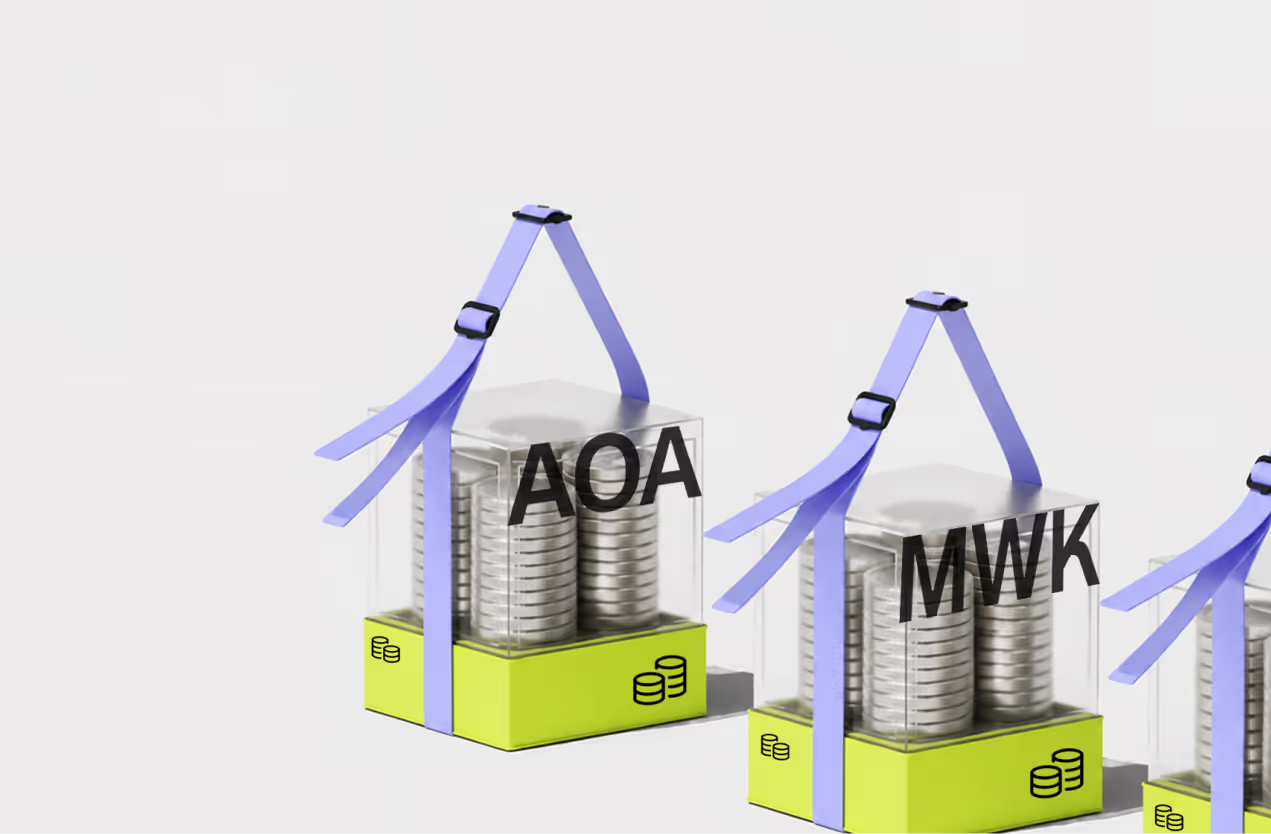
That gap between the quoted spread and the all-in delivered cost is the single most underpriced risk in African corporate treasury

Most enterprise treasury teams track FX costs as the spread between their quoted rate and the interbank mid-rate. In liquid G10 corridors, that number tells you almost everything. In African cross-border corridors, it tells you almost nothing.
The real cost of moving money across African borders lives in the gaps between rate quotes, in settlement delays that turn a 2% spread into a 5% loss, in liquidity windows that close without warning, and in parallel market dynamics that distort every benchmark you rely on.
For CFOs and heads of treasury managing payroll, supplier payments, or receivables collection across the continent, the core problem is structural unpredictability: not just higher costs, but costs that shift depending on when, how, and through whom you execute.
The gap between quoted and delivered cost
The World Bank's Remittance Prices Worldwide database, the most widely cited source on cross-border payment costs, reports that the average cost of sending $200 to sub-Saharan Africa sits at approximately 7.9%, compared to a global average of roughly 6.2% (Q4 2024 data). That premium alone is significant: sub-Saharan Africa remains the most expensive region in the world for cross-border transfers, a distinction it has held for over a decade despite the G20's SDG 10.c target of reducing costs to 3% by 2030.
But for enterprise-scale transactions, the Remittance Prices Worldwide data understates the problem. Those figures capture retail corridors at a $200 notional. Corporate treasury teams moving $50,000 to $5 million per transaction face a different cost structure entirely, one shaped by
That gap between the quoted spread and the all-in delivered cost is the single most underpriced risk in African corporate treasury. You get a rate on Monday, you settle on Thursday, and the number that hits your account bears little resemblance to the one you agreed to.
Not all corridors are the same
The mistake most treasury teams make is treating Africa as a single risk environment, applying the same hedging logic and operational playbook to a payment into Senegal (CFA franc, pegged to the euro) as they would to a payment into Nigeria (naira, recently liberalized and highly volatile). These are fundamentally different problems.
Two things matter most when you're trying to understand what a given corridor will cost you: how deep the liquidity is, and how stable the rules are.
Liquidity depth is about how reliably you can execute at or near the quoted rate for your transaction size. The South African rand, for instance, is the 18th most traded currency pair globally. You can move serious volume without moving the market. The Congolese franc or the Mozambican metical? A $100,000 transaction can shift the rate.
Regime stability is a different kind of risk. A currency can be perfectly stable in price terms but deeply unpredictable in practice if the central bank periodically restricts access to FX, changes repatriation rules, or introduces new documentation requirements mid-transaction.
When you map African corridors against these two dimensions, some patterns emerge
The PAPSS promise and the intra-African corridor problem
The Pan-African Payment and Settlement System (PAPSS), launched by the African Export-Import Bank (Afreximbank) in January 2022, was designed to address the correspondent banking dependency by enabling direct clearing and settlement of intra-African payments in local currencies. For example, with PAPSS, if a Kenyan company can pay a Ghanaian supplier directly in shillings and cedis, without routing through New York or London, the cost and time of the transaction should drop dramatically.
PAPSS has made meaningful progress. As of early 2025, it had connected central banks across more than 15 African countries and processed growing volumes. But its impact on enterprise treasury operations remains constrained by two factors.
First, PAPSS settles at a rate, but it does not create the underlying FX liquidity. If the GHS/KES market is thin (and it is), PAPSS facilitates the transaction but does not solve the pricing problem. The gap between quoted and delivered cost persists.
Second, corporate adoption requires integration into existing ERP and treasury management systems, which means API-level connectivity, automated reconciliation, and compliance workflows that match the standards of SWIFT-based infrastructure. Most enterprises still operate on legacy rails because the integration cost of switching is high.
The intra-African corridor problem is fundamentally a liquidity problem layered on top of an infrastructure problem. Solving one without the other produces faster payments that are still expensive, or cheaper quotes that cannot be reliably executed.
What smarter FX execution looks like in practice
Once you understand how different corridors behave, the operational playbook starts to differentiate.
In liquid, stable corridors, you optimize for spread. Standard approaches work. Benchmark against interbank rates and negotiate accordingly.
In corridors with good liquidity but unpredictable regimes, the value is in execution speed and rate-lock windows, not in spread compression. Infrastructure that can settle in minutes rather than days is worth more than a 10 basis-point rate improvement. And you need to monitor central bank communications as actively as you monitor rates.
In thin but stable corridors, the game is batching and predictability. Build payment schedules around known liquidity windows. Accept slightly wider spreads in exchange for reliable execution.
And in corridors where thin liquidity meets regime volatility, optionality becomes everything. Multi-rail infrastructure, the ability to switch between fiat settlement, stablecoin bridges, and local collection networks based on real-time conditions, is the only reliable way to maintain settlement certainty. This is where the traditional correspondent banking model breaks down most visibly, and where infrastructure designed specifically for these conditions creates the most value.
The infrastructure layer matters more than the rate
The payments industry has spent years optimizing for spread: finding the cheapest rate, negotiating the tightest margin. In G10 corridors, that makes sense. In African corridors, spread is often the least important variable.
Settlement speed, rate validity windows, multi-rail failover, local market access for collections and payouts, and the ability to programmatically route payments based on real-time corridor conditions: these are the factors that determine whether a quoted rate becomes a delivered rate.
CrissCross builds infrastructure around this reality, combining local fiat rails, stablecoin settlement, and API-driven routing across 30+ African markets to close the gap between quoted and delivered cost where it matters most.